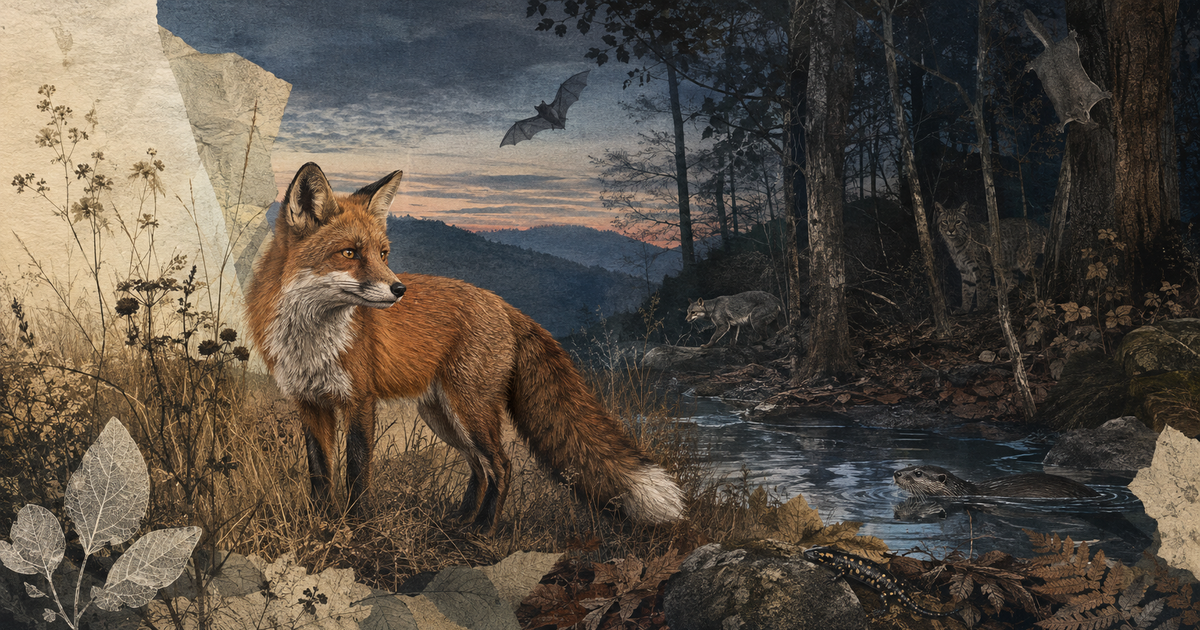
A red fox at the edge of a field can appear like a bright interruption: rust-colored coat, black lower legs and a white-tipped tail moving quickly between cover and open ground. Its brief visibility makes it memorable. Its adaptability makes it a useful guide to the complicated spaces where forest, farm, neighborhood and road meet.
The red fox is also an invitation to notice the animals that remain less visible. Southern Appalachian habitats support an exceptional range of mammals, while mountain streams and wet forests sustain amphibian life that may reveal itself only under the right temperature, season and rain.
Key points
- Red foxes often use mixed landscapes containing both cover and open feeding areas.
- The native gray fox can climb trees and is not simply a color variation of the red fox.
- Tracks, calls, scat and camera records often reveal wildlife more reliably than direct sightings.
- Observation should never require baiting, handling or forcing an animal into view.
The red fox at the edge
Red foxes are highly adaptable and occur across much of North America. In the eastern United States, their history includes both native range expansion and ancestry associated with foxes introduced from Europe. That mixed history is a reminder that ‘native’ can require more precision than a familiar label suggests.
In Appalachian landscapes, red foxes are often associated with mixtures of forest and open ground. Their hearing helps them locate small prey, sometimes beneath vegetation or snow. They also consume insects, fruit and other seasonally available foods.
Meet the less visible neighbors
The gray fox is a separate native species, usually more muted in color and capable of climbing trees. Bobcats are elusive, well-camouflaged cats associated with wooded and rocky cover. River otters move through connected aquatic habitats. Raccoons, opossums and skunks are more familiar generalists, while flying squirrels and many bats can remain almost entirely outside daytime observation.
The Blue Ridge Parkway has documented more than 70 mammal species, illustrating the biological range of the southern Appalachians. Mammals are only part of the story. Salamanders, frogs, turtles, snakes, pollinators and synchronous fireflies occupy different layers of the same living field.
Presence without performance
Wild animals spend energy to feed, avoid predators, reproduce, migrate and survive weather. When people approach too closely, surround an animal or repeatedly call it into view, the encounter becomes a cost imposed for our experience.
A better practice is to read signs. Tracks in mud, a feather left legally untouched, an opening in grass, a call at dusk or a trail-camera record can confirm presence without demanding performance. If wildlife changes direction, stops feeding, gives an alarm call or focuses continually on the observer, the observer is too close.
- Watch from a distance with binoculars or a long lens.
- Never feed foxes, coyotes, raccoons or other wild mammals.
- Do not handle bats, young wildlife or apparently injured animals.
- Use licensed wildlife rehabilitators and public agencies when intervention may be necessary.
- Drive slowly at dawn, dusk and known wildlife crossings.
Native habitat begins with relationships
A native-species landscape is not created by placing one decorative plant or installing one box. It is built through relationships among clean water, food plants, mature trees, leaf litter, dead wood where safe, nesting sites, dark night conditions and connected cover.
Those relationships can be supported at many scales: a yard planted for birds and pollinators, a stream buffer retained during development, a road project designed around crossings or a public landscape managed for more than appearance.
From Georgia to a national field of attention
The exact community of species changes across the United States, but the discipline of observation travels well. Learn the local habitat. Confirm identification. Respect protected species and public-land rules. Distinguish what is common from what is merely conspicuous. Treat a sighting as one observation, not proof of a population trend.
The red fox brings us to the edge. From there, the larger discovery is not a checklist of animals but a way of seeing: every place contains lives, routes and relationships operating beneath ordinary human attention.