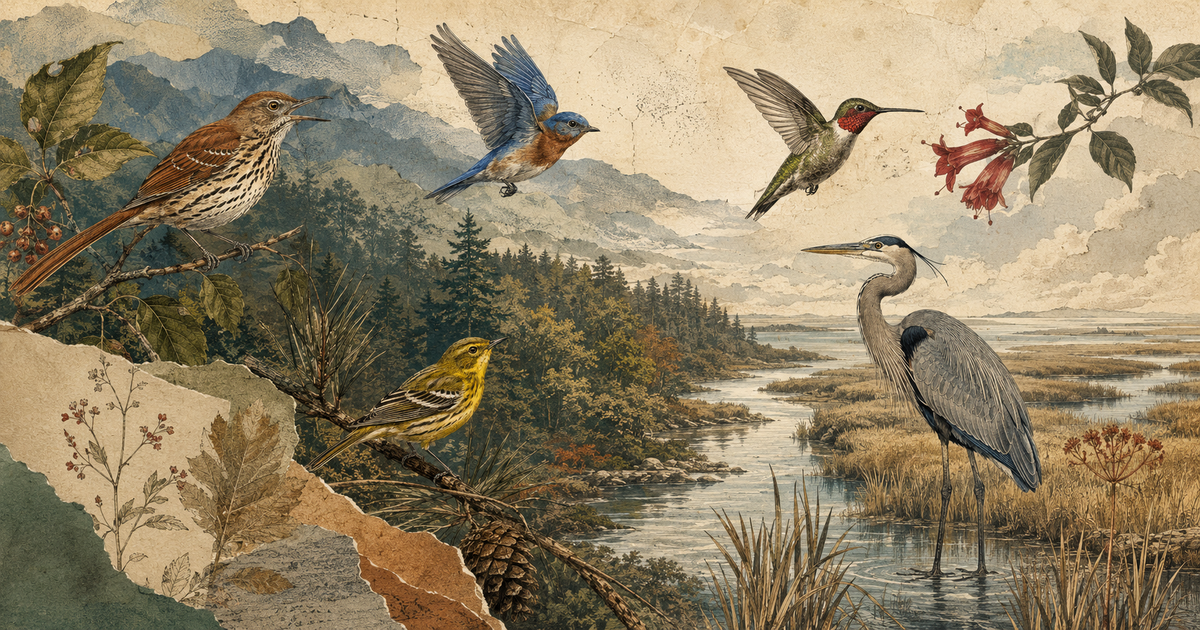
Birds make geography visible. A brown thrasher turning leaves beneath a shrub, an eastern bluebird crossing a pasture, a pine warbler moving through needles or a great blue heron lifting from a riverbank each reveals a different relationship between species and place. Together, they show that Georgia is not one habitat but a meeting of mountains, piedmont, wetlands, rivers, forests, farms and coast.
Some birds remain through much of the year. Others arrive for a season, stop to restore energy or pass overhead almost unnoticed. Their movements connect neighborhood plantings and North Georgia ridges with national wildlife refuges, coastal resting grounds and migration systems extending across the Americas.
Key points
- Georgia’s varied landscapes support resident, breeding, wintering and migratory birds.
- A local patch of habitat can be part of a continental migration system.
- Native vegetation, clean water and undisturbed nesting cover help many species at once.
- Responsible observation means keeping distance and leaving nests, eggs and feathers undisturbed.
Five birds, five ways of reading Georgia
The brown thrasher, Georgia’s state bird, searches leaf litter with a long curved bill and rewards people who preserve shrubs and ground cover. The eastern bluebird favors open country with nearby cavities. Ruby-throated hummingbirds link flowering plants with an extraordinary migratory life. Pine warblers disclose the presence of pine habitat, while great blue herons turn rivers, ponds and marshes into visible feeding grounds.
These are not the only birds worth noticing. They are accessible entrances into habitat literacy: shape, movement, call, season and behavior can tell a reader as much about the surrounding environment as the bird itself.
- Observe behavior before reaching for identification.
- Record habitat, date and time with the species name.
- Listen for calls without using repeated playback near nesting birds.
- Use binoculars or a camera rather than approaching wildlife.
Georgia inside a continental movement
The United States is crossed by four primary north-south migratory flyways. Georgia’s position in the Southeast places its forests, ridges, rivers and coast within movements that cannot be conserved by one town or one state alone. The U.S. Fish and Wildlife Service describes migratory-bird conservation as a partnership concerned with populations, habitats and the ecological, recreational and economic value of birds.
The scale can be remarkable. Along Georgia’s coast, protected islands and marshes provide nesting, feeding or resting habitat for birds whose annual journeys reach far beyond the state. Inland, Kennesaw Mountain National Battlefield Park has documented more than 200 bird species and is recognized by the National Park Service for its migratory diversity.
The Appalachian layer
The Appalachian landscape adds elevation, forest structure, river valleys and seasonal change. A bird may use lowland cover during migration, mature forest for breeding, an opening for feeding or a water corridor for movement. What looks like a scenic mosaic to a visitor can function as a network of shelter, food and passage.
This is why fragmentation matters. A surviving tree line, connected stream corridor or native garden may not appear monumental, yet it can become one workable interval within a much larger journey.
Create habitat without turning wildlife into decoration
Georgia DNR recommends habitat elements such as vegetation layers, standing dead trees where safe, logs, nest boxes and other shelter appropriate to the location. Native plants can provide food and cover while reducing dependence on artificial feeding. Clean feeders, when used, should never replace habitat or create unhealthy crowding.
Wild birds are protected by state and federal laws with limited exceptions. Nests, eggs and feathers should be left where they belong. The most respectful bird photograph is one made without forcing the bird to abandon feeding, shelter or young.
- Plant native flowers, shrubs and trees suited to the site.
- Reduce unnecessary nighttime lighting during migration seasons.
- Keep cats indoors or safely contained.
- Make windows more visible to birds where collisions are a concern.
- Join a guided bird walk or contribute observations through a recognized community-science program.
A national story beginning outside the window
Birdwatching does not require a distant expedition. It begins by noticing what uses the spaces already around us. That local attention can grow into a national understanding: birds cross political boundaries, depend upon chains of habitat and make the health of distant places relevant to one another.
For ORG Times, Georgia’s birds are both wildlife and living signals. They show how a small place participates in a continental system—and how careful observation can turn familiarity into responsibility.