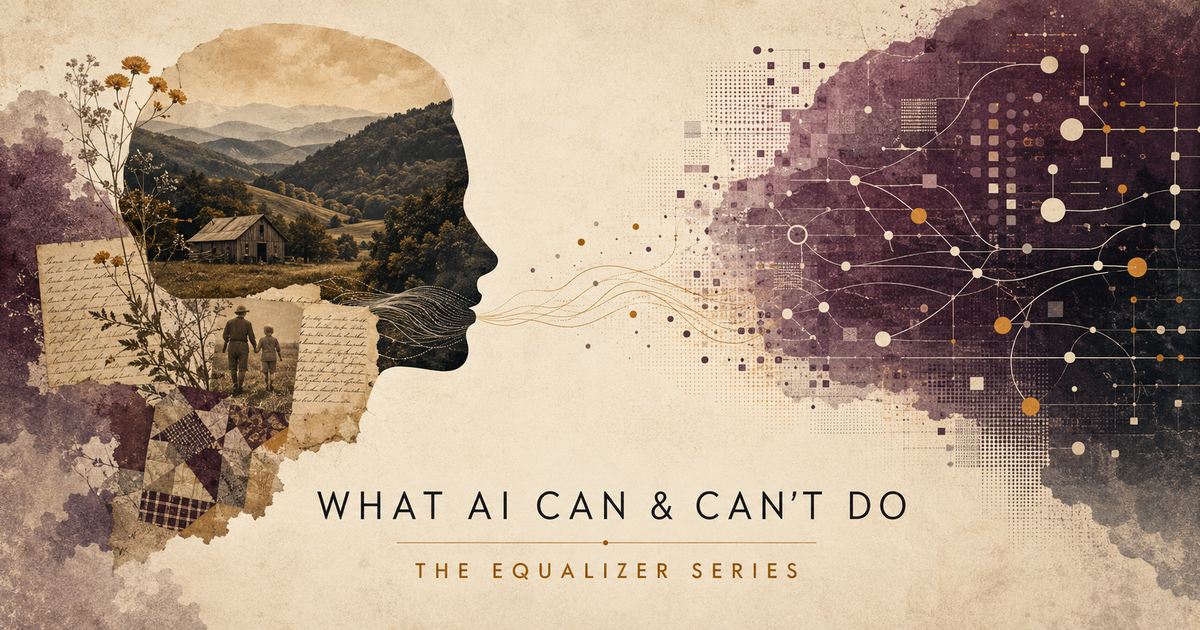
Artificial intelligence can respond to a question in seconds. It can explain a complicated subject, recognize connections, adapt its language and produce an answer that sounds remarkably thoughtful. That performance can feel like understanding.
But producing language that fits a situation is not the same as fundamentally understanding the situation. AI does not know what a business means to the family that built it. It does not experience the uncertainty of making payroll, the responsibility of serving a community or the personal history contained within a founder's unfinished idea.
Key points
- Convincing language is not proof of human-like understanding.
- AI can simulate emotionally aware communication without experiencing emotion.
- Incomplete context can produce polished but unsupported assumptions.
- Human beings must establish meaning, evidence and responsibility.
What this observation currently supports
- Status
- Opening research proposition · field testing begins with this series
- Observation
- During sustained human-led use, AI can produce language that appears thoughtful and emotionally attentive while also adding assumptions or certainty not established by the original context.
- Supported claim
- Fluent generative output can be useful without being independently reliable; important claims still require evidence and human review.
- Uncertainty
- No single test can resolve philosophical questions about machine consciousness or establish how every model behaves in every context.
- Next evidence
- Repeat the same questions with complete, incomplete, contradictory and misleading context; record assumptions, uncertainty disclosures, corrections and factual accuracy.
What the system is actually doing
A language model processes the information it receives and generates a response shaped by learned patterns and the current context. It can connect information, compare explanations and predict which continuation is likely to be useful. That is a substantial capability. It is not the same as knowing through a body, history, relationship or personal consequence.
This distinction becomes especially important when a response uses emotionally attentive language. The system can identify emotional cues and respond in a way that resembles empathy. It does not feel the emotion it is addressing. The behavior may be supportive, but the experience remains human.
When probability begins to resemble certainty
When information is missing, AI may attempt to complete the pattern. It can introduce assumptions, share more than the person needs or make an early conclusion sound settled. OpenAI's published research describes hallucinations as plausible but false outputs and examines why systems may be rewarded for guessing rather than acknowledging uncertainty.
The practical lesson is not to distrust every answer. It is to separate fluency from verification. A well-written response can be a useful beginning while still requiring confirmation before it influences a consequential decision.
- What information did the person actually provide?
- What did the system infer or add?
- Which claims can be checked?
- What remains uncertain?
- Who is responsible for the decision?
Our working definition: Advanced Intelligence
For this series, publisher Lalit Devgan uses Advanced Intelligence as a practical human-centered term: a human-directed capability that can organize scattered knowledge, recognize patterns, develop ideas, simulate emotionally aware communication and accelerate useful work.
It can help a person work more wisely and efficiently when it receives better context, evidence and correction. The wisdom is not independently possessed by the software. It emerges through a human process of judgment, verification, restraint and responsibility.
The first Equalizer field test
ORG Times will compare responses to the same practical question under four conditions: sufficient context, missing context, contradictory context and a deliberately false premise. Reviewers will record whether the system identifies uncertainty, invents a bridge, requests clarification or confidently proceeds.
The purpose is not to stage a contest between people and software. It is to give readers a repeatable way to experience the difference between an answer that sounds understanding and an answer that is adequately grounded.