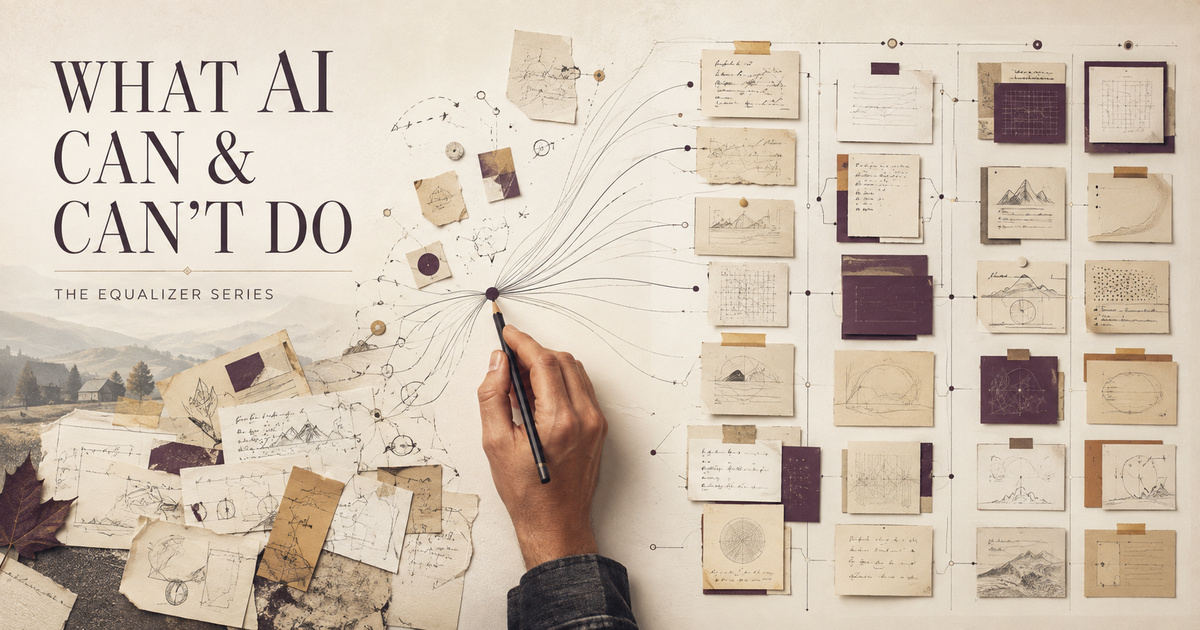
Many meaningful ideas do not begin as organized plans. They begin as scattered notes, unfinished sentences, remembered conversations, personal observations and connections that the originator can sense but has not yet fully expressed.
This is one of the areas where advanced intelligence can be exceptionally useful. It can group fragments into themes, compare one thought with another, identify recurring ideas and present the material as an outline, article, plan or working model.
Key points
- AI can reduce the distance between scattered knowledge and usable structure.
- Organization is not ownership, authorship or final interpretation.
- A polished structure may distort the originator's true intention.
- Human review is part of authorship—not a final formality.
What this observation currently supports
- Status
- Observed working capability · controlled comparison proposed
- Observation
- Fragmented notes and spoken ideas can be converted rapidly into themes, sequences and working drafts, but the proposed organization can also introduce relationships or emphasis not intended by the originator.
- Supported claim
- Generative AI can assist with synthesis and drafting; the originator must still validate meaning and approve the final expression.
- Uncertainty
- Usefulness will vary with the quality of the source material, the instructions, the subject and the reviewer's ability to detect drift.
- Next evidence
- Compare original fragments with AI-organized versions; have originators score preservation, clarity, added assumptions, required corrections and time saved.
A capability that can reduce organizational disadvantage
A rural founder may understand a local need deeply but lack a strategist, analyst, editor and systems designer. A small community organization may possess years of knowledge without having the staff time to convert it into a research question or publication.
Advanced intelligence can make portions of those capabilities more accessible. It can help reveal patterns across material, produce alternative structures and give the originator something concrete to accept, reject or reshape.
Where the meaning can change
The system may connect two thoughts that the originator considers unrelated. It may strengthen a secondary point until it overshadows the original purpose. It may also add language so polished that the person forgets the idea remains incomplete.
The strongest safeguard is a visible chain of authorship. Preserve the original observation, identify what the system added and record the human corrections that established the final meaning.
- Original human observation
- AI-proposed organization
- New assumptions or connections
- Human corrections and rejections
- Evidence supporting the final version
- Named human approval
Our field method
Participants will provide de-identified collections of notes or idea fragments and privately record their intended meaning before the material is organized. Advanced intelligence will then group, sequence and summarize the content without receiving the intended conclusion.
The originator will score what was preserved, what became clearer, what was misunderstood, what was added and whether the result still represents the original intention. Time spent organizing and correcting will also be recorded.
The practical equalizer
The equalizing possibility is not that software becomes the author. It is that more people gain access to the organizational assistance needed to make their own knowledge visible and usable.
When authorship remains clear, AI can help human intelligence become more organized and expressive. Meaning, consent and responsibility remain with the person whose knowledge is being developed.