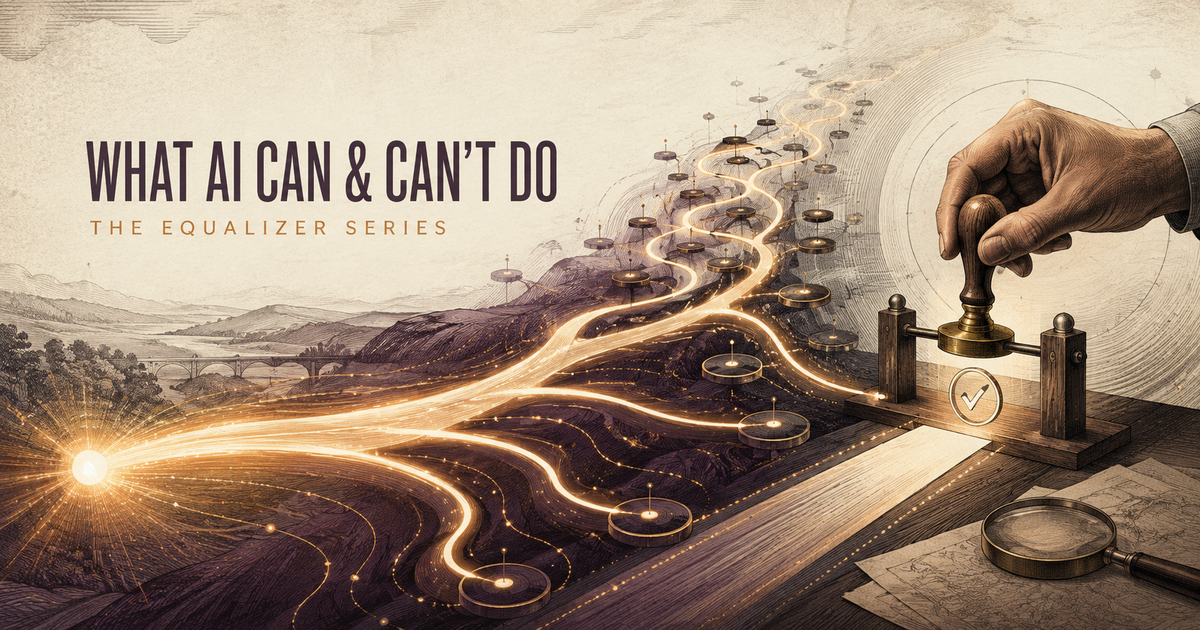
Artificial intelligence can move an idea forward with extraordinary speed. A person can begin with a single observation and, within one working session, develop research questions, compare approaches, organize a publication, identify missing information and create an initial operating plan.
That acceleration can change who gets to participate in innovation. It can also make an immature idea appear finished before its assumptions, evidence or consequences have been examined.
Key points
- AI can compress early development time and expand the number of possibilities considered.
- Speed and polish do not establish accuracy, value or readiness.
- AI can shape an idea as well as organize it.
- Human verification and responsibility remain the final control.
What this observation currently supports
- Status
- Productivity potential supported externally · local field measurement begins next
- Observation
- Human-led AI collaboration can move from an early observation to a structured concept far faster than an unaided process, while also introducing new directions and unsupported assumptions.
- Supported claim
- Controlled studies have found productivity improvements in defined knowledge-work tasks; those findings do not prove that every faster output is correct or valuable.
- Uncertainty
- Benefits and risks vary by task, participant, model, context, verification method and the distance between the task and the system's reliable capability frontier.
- Next evidence
- Compare human-only, limited-context AI and human-led AI workflows for time, clarity, originality, factual accuracy, correction burden and final usefulness.
When speed broadens participation
A small business may not employ a research team. A rural founder may not have continuous access to strategy, analysis, editing and systems design. Advanced intelligence can make parts of those capabilities available inside one human-led working process.
Research published in Science found substantial gains in speed and evaluated quality for a defined set of professional writing tasks. That is meaningful evidence of task-level productivity—not permission to generalize the result to every decision or domain.
AI does not only accelerate the idea—it can change it
While developing an idea, the system may introduce a connection the originator had not considered, ask a question that changes the direction or combine separate observations into a new possibility. This can be genuinely valuable.
It can also reinforce a weak assumption, redirect the original intention or generate so many plausible possibilities that selection becomes harder. The person must distinguish expansion from evidence.
The Equalizer comparison
ORG Times will develop the same early-stage idea through three approaches: human work without AI assistance, AI production using limited context and human-led AI collaboration with documented review.
The comparison will not declare a universal winner. It will measure what each process contributes and what it requires from the person responsible for the outcome.
- Completion time
- Clarity and usefulness
- Number and range of ideas
- Factual or contextual errors
- Human correction time
- Fidelity to the original intention
From efficiency toward wisdom
Advanced intelligence can help a person become more efficient by reducing repetition, organizing complexity and developing alternatives. It can support wiser work by surfacing consequences, counterarguments and missing evidence.
Wisdom is not produced by speed alone. It appears when capability is joined with lived context, truthfulness, restraint and responsibility. AI may help shape the idea; the human must decide what deserves to become real.
The series principle
Advanced intelligence does not replace human intelligence. It helps human intelligence become more organized, expressive, capable and efficient.
Its value becomes wisdom only when a human supplies context, verifies the evidence and accepts responsibility for the outcome.