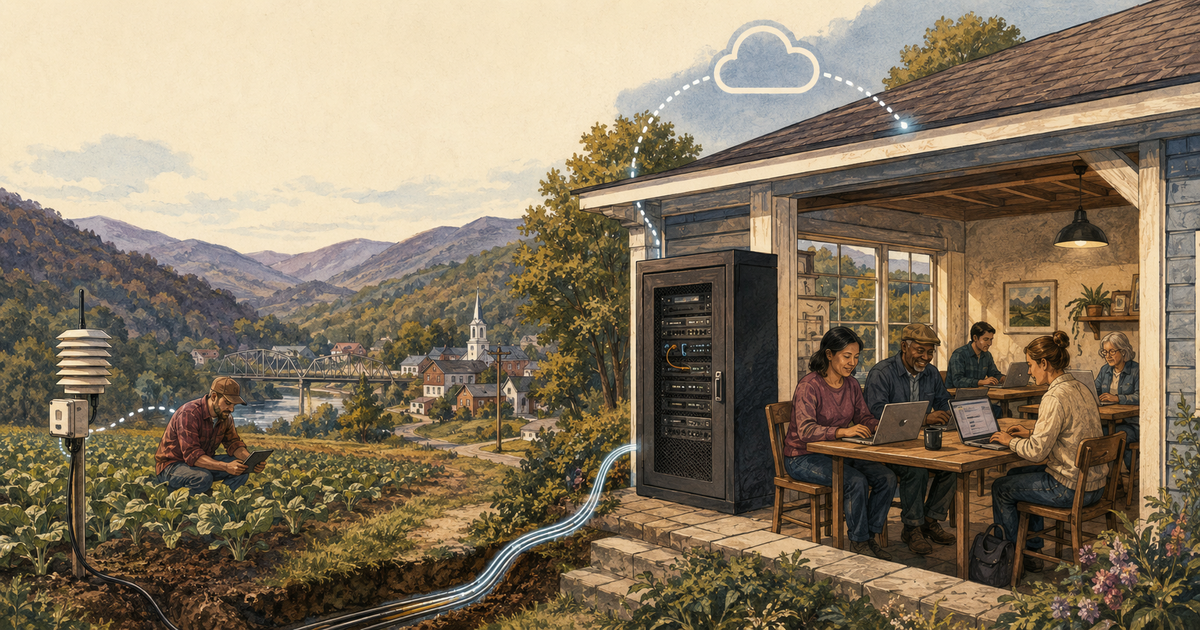
The AI economy runs on large computing systems, but that does not mean every rural community must host those systems. A town can access advanced cloud services over reliable broadband while concentrating local investment on the capabilities that translate technology into community value.
That distributed model is less visually dramatic than a hyperscale campus. It may be more directly connected to everyday participation: residents learning new skills, small businesses modernizing operations, students building applications, farms using sensors, institutions protecting data and local firms serving customers beyond the region.
Key points
- Cloud computing allows rural users to access large-scale capability without hosting it locally.
- Edge computing is useful when latency, privacy, continuity or bandwidth justify local processing.
- Broadband alone does not guarantee adoption, enterprise or ownership.
- Hyperscale proposals require project-specific electricity, water, land, tax and employment analysis.
What this observation currently supports
- Status
- Technical alternatives supported; local architecture not yet designed
- Observation
- Cloud, edge, broadband, workforce and entrepreneurship research supports distributed ways to participate in the digital economy.
- Supported claim
- A hyperscale data center is not a technical prerequisite for community-level AI adoption or digital enterprise.
- Uncertainty
- The best mix of cloud and local compute depends on actual workloads, privacy, resilience, cost and skills.
- Next evidence
- Inventory community use cases and measure latency, data sensitivity, uptime, bandwidth, energy, ownership and total cost before specifying equipment.
What community digital infrastructure includes
Community digital infrastructure is broader than computing hardware. It includes reliable connectivity, affordable devices, accessible places to learn and work, people who can apply technology, secure data practices, project leadership, enterprise support and connections to markets.
CORI has described broadband, coworking or entrepreneurship spaces and local leadership capacity as necessary elements of rural digital economies. EDA's Tech Hubs model similarly connects workforce, capital, business formation, commercialization and technology deployment.
- Broadband and resilient connectivity
- Devices and accessible community spaces
- AI, software and cybersecurity skills
- Cloud applications and shared services
- Right-sized local or edge computing where justified
- Local enterprise, ownership and market access
Cloud, edge and local compute in plain language
Cloud computing means using computing and storage operated elsewhere and reached through a network. Edge computing places some processing closer to where data is created. Local compute means equipment directly controlled on site or within the organization.
Use cloud when flexibility, scale and managed services matter. Consider edge when response time, privacy, limited connectivity or operational continuity requires nearby processing. Keep local systems when direct control or offline operation justifies the cost and responsibility. Many useful systems combine all three.
A simple use case: a rural farm and learning lab
A farm sensor can collect soil-moisture data. A small local gateway can continue collecting when internet service is interrupted. A cloud application can store history, generate analysis and make it available to a teacher, farmer or student. The community needs connectivity, devices, training and secure administration—not a hyperscale facility.
The same pattern can support telehealth access points, tourism information, small-business automation, library learning programs and community data projects.
Why hyperscale is a separate siting decision
Hyperscale data centers are industrial-scale infrastructure with concentrated electricity, cooling, transmission, land and capital requirements. Berkeley Lab reported that U.S. data centers used about 4.4 percent of national electricity in 2023 and projected a range of 6.7 to 12 percent by 2028 in its 2024 analysis.
Those national estimates do not determine whether a specific project is appropriate. They show why every proposal needs transparent local analysis of electricity, water, grid upgrades, tax incentives, construction and permanent employment, land use, noise, backup generation, public exposure and opportunity cost.
Invest where participation happens
The distributed alternative directs attention to the last mile of economic participation: whether a resident can learn, whether a business can adopt, whether a local institution can administer a system and whether the resulting platform, data, intellectual property and customer relationship remain locally valuable.
This is not an argument against all data centers. It is an argument against confusing the location of machines with the distribution of opportunity.