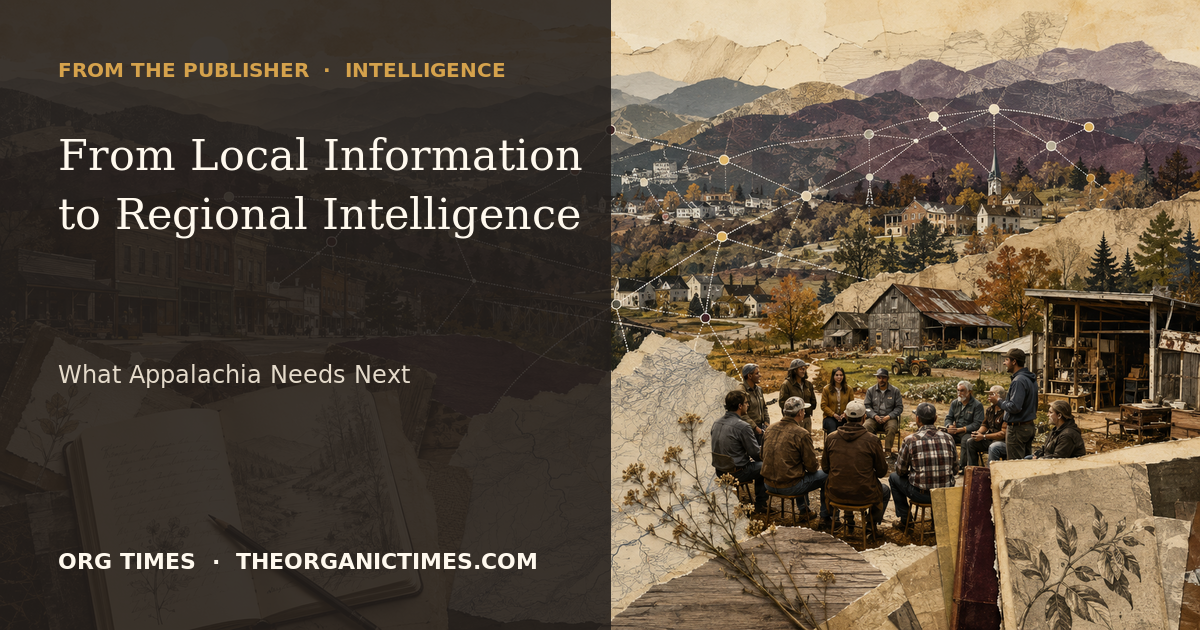
Every region generates information. Businesses receive inquiries. Visitors reveal patterns through what they search for and where they go. Nonprofits hear recurring needs. Educators observe skills gaps. Local governments, chambers and service providers collect records. Residents understand changes that may not yet appear in a formal report.
The challenge is not simply collecting more. It is turning scattered signals into regional intelligence without removing the context that gives them meaning. Appalachia needs information systems that are locally grounded, responsibly governed and useful to people making decisions now.
Key points
- Local knowledge and structured data are strongest when used together.
- Regional intelligence should begin with a defined decision or question.
- Consent, limitations and human interpretation are part of research quality.
- Publishing can return useful findings to the communities that produced the evidence.
Why national averages are not enough
National reports can show large trends, but they rarely explain the operating reality of a five-person business in a mountain county, a seasonal destination, a rural nonprofit or a professional serving several small communities. Local anecdotes provide depth but cannot always show whether an experience is isolated or widespread.
Regional intelligence works between those scales. It brings enough structure to identify patterns while preserving enough context to understand why those patterns exist here.
Start with the decision—not the database
Data collection often begins with a platform, survey or available dataset. A stronger process begins by asking what decision must improve. Is a business choosing its next technology investment? Is a training provider deciding which skills to teach? Is a sponsor looking for a credible public-benefit initiative? Is a community trying to understand visitor demand without overwhelming local capacity?
A clear decision defines the minimum information required, who should contribute, how it may be used and what level of uncertainty is acceptable.
- State the question and intended use.
- Collect only what is necessary.
- Separate identifiable records from aggregated findings.
- Document missing perspectives and limitations.
Treat lived experience as evidence with context
Numbers are not the only form of evidence. Interviews, field observations, project records, service requests and first-hand experience can reveal why a pattern exists. They also carry limits. One person’s experience should not automatically become a regional conclusion.
The role of careful research is to preserve the value of lived experience while placing it alongside other signals. Human review is essential because categories can simplify reality faster than they explain it.
Build a responsible regional learning loop
Intelligence should return value to the region. Local organizations contribute signals; researchers organize and interpret them; publishers make selected findings understandable; businesses and institutions act; outcomes then produce new evidence.
This creates a living loop: listen, observe, structure, publish, act, measure and learn. It is more useful than a report that appears once, circulates briefly and disappears from the operating life of the community.
The publishing role in regional intelligence
ORG Times can make research visible without pretending every article is a research report. We can distinguish reporting, analysis, publisher perspective, sponsored work and formal research. We can connect findings to source material, disclose limitations and create public summaries that remain useful beyond a single announcement.
The next stage for Appalachia is not one centralized voice claiming to know the region. It is a connected intelligence field in which places retain their distinct knowledge while contributing to decisions across the wider region.