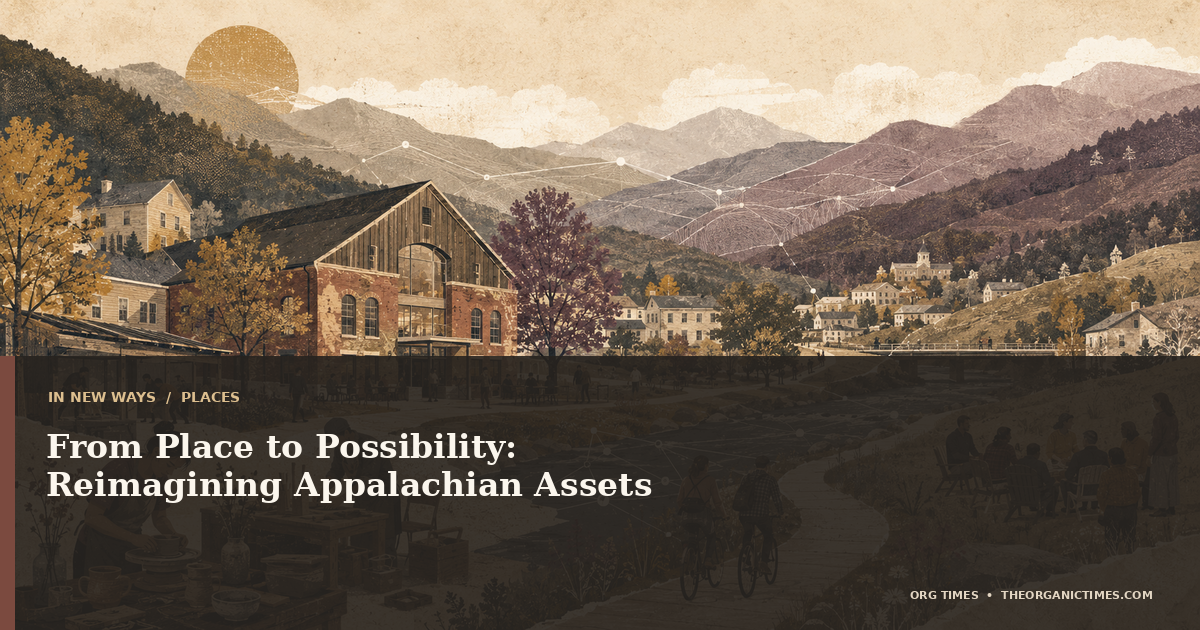
Appalachian communities hold assets that are easy to see and difficult to fully value: historic buildings, working landscapes, rivers, trails, downtowns, gathering spaces, local knowledge, cultural traditions and small enterprises. These assets are often treated separately—as tourism, real estate, heritage, business or public space—even though people experience them as one place.
Reimagining a local asset does not mean discarding its history or forcing it into a fashionable development model. It means understanding the relationships around it and designing new ways for people to gather, learn, create, buy, build and contribute.
See the asset as a living context
A building is more than square footage. Its location, story, access, surrounding businesses and community memory shape what it can become. A river is simultaneously an ecosystem, visitor experience, infrastructure and part of everyday life. Starting with context prevents a project from optimizing one use while weakening the wider place.
Layer uses instead of depending on one
A rural property might support events, learning, workspace, digital production, demonstrations and visitor experiences at different times. A downtown initiative might connect storytelling, wayfinding, shopping and professional services. Layering can create resilience, but only when capacity, zoning, safety, ownership and operating responsibility are clear.
- Begin with the smallest complete experience.
- Test demand before permanent expansion.
- Separate public-benefit and commercial activities appropriately.
- Measure community impact as well as transactions.
Build a digital doorway into the physical place
A place can become discoverable before a visitor arrives and remain connected after the visit. Original maps, guides, booking pathways, virtual experiences, local product links and well-structured stories can extend participation. The digital layer should lead people toward accurate information and real local value rather than reducing the place to a generic attraction.
Connect local value to regional pathways
One community does not need to offer everything. A stronger Appalachian network can help places specialize and connect: a maker to a market, a visitor route to several towns, a workforce program to regional employers or a local pilot to wider research. The opportunity is not uniformity. It is a visible pathway through distinct places.
Let stewardship define innovation
Innovation should leave the asset and its relationships more capable than before. That requires listening, small-scale testing, transparent sponsorship, responsible technology and respect for the people who live with the outcome after visitors and project teams leave. A place moves forward when new possibility strengthens belonging rather than replacing it.