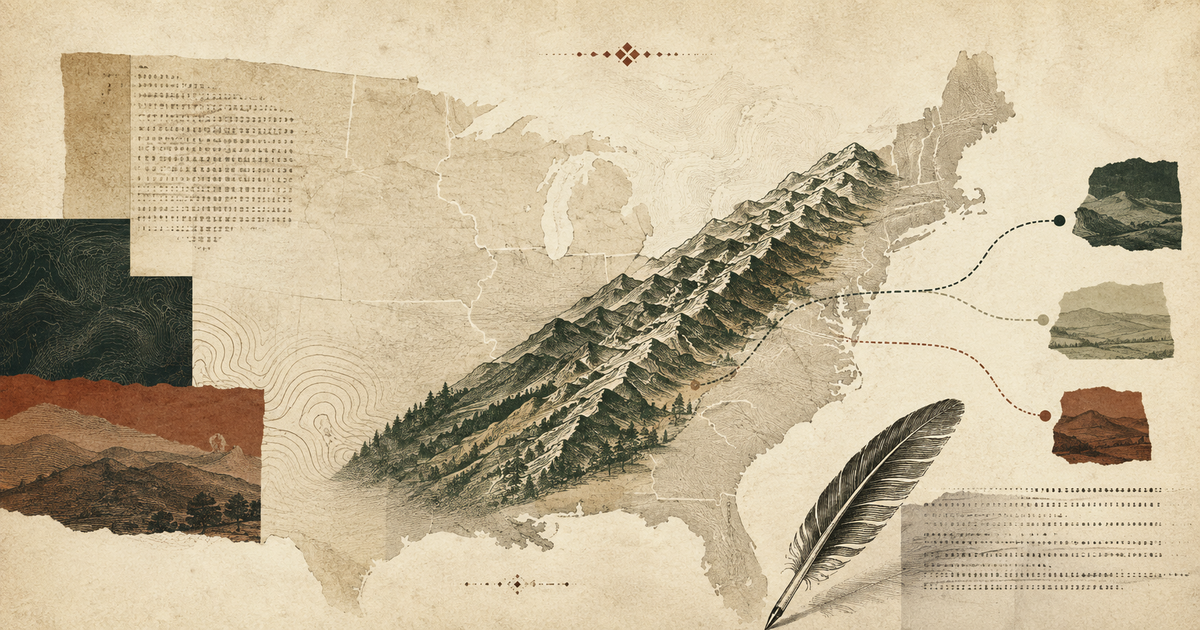
A remembered line about Appalachia once being considered as a name for America led ORG Times back through maps, magazine records and nineteenth-century writing.
The search produced a clear historical foundation. In an 1839 essay titled National Nomenclature, Washington Irving proposed retaining the phrase The United States while substituting Appalachia or Alleghania for America. Irving preferred Alleghania. Edgar Allan Poe later made the stronger argument for Appalachia.
Key points
- Washington Irving proposed Appalachia or Alleghania in 1839.
- Irving personally preferred Alleghania.
- Edgar Allan Poe later advocated specifically for Appalachia.
- The proposal was discussed publicly but never officially adopted.
What this observation currently supports
- Status
- Source-backed historical record · exact magazine artifact still under review
- Observation
- Primary nineteenth-century texts confirm that Appalachia was proposed and later advocated as a distinctive national name for the United States.
- Supported claim
- It is accurate to say the name was proposed and publicly argued.
- Uncertainty
- The surviving evidence reviewed here does not show that the name was formally selected, approved or adopted. The exact National Geographic paper cutout remembered by the publisher has not yet been recovered.
- Next evidence
- Locate and document the original clipping, including publication, issue, page, captions and surrounding context, before attributing its exact wording.
What Washington Irving actually proposed
Irving argued that the young republic needed a national designation more distinctive than America, a name shared across the continents. He looked to the Appalachian or Alleghany mountains as a defining feature running through the original confederacy.
His proposed formulation preserved The United States and the familiar initials U.S.A. Irving wrote that Appalachia or Alleghania could replace America, while explicitly stating his own preference for Alleghania.
Why Edgar Allan Poe favored Appalachia
Poe later argued that Appalachia was distinctive, Indigenous in origin and connected to one of the country's defining geographic features. He also preferred the sound of Appalachia and expressed hope that the country would assume the name.
Poe's advocacy strengthens the historical record, but advocacy is not adoption. The distinction matters because a compelling forgotten proposal can easily become overstated when it is retold.
The name is older than the national proposal
The Library of Congress traces an early form of the name to the Gutiérrez map of 1562, which labeled a southeastern region Apalchen. Later maps used related spellings for the region and its mountains.
That longer cartographic history helps explain why Appalachia could carry national meaning for Irving and Poe. The word was already connected to land, people and the evolving European representation of North America.
What we can responsibly share
We can say that Appalachia was proposed as a distinctive name for the United States and that major American writers publicly debated its merits. We cannot say it became an official finalist, was formally chosen or was rejected through a documented government decision without additional evidence.
That careful wording does not weaken the story. It makes the story durable enough to support further research.